Anatomy of a photo #16: Morning lily pads


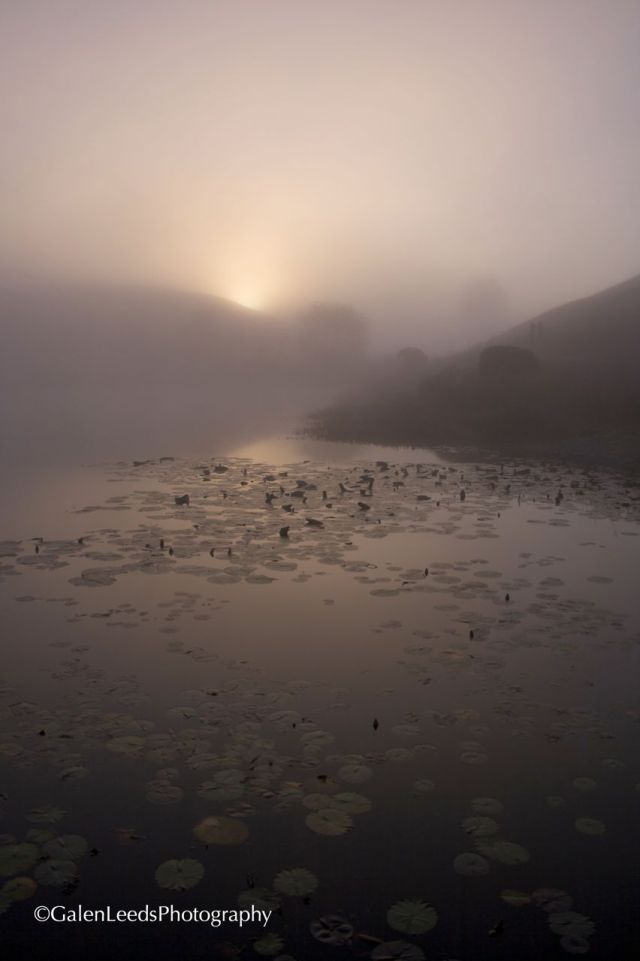
Early morning picture of lily pads on a pond

I made this image in my early days of digital photography, before I knew all the ins and outs of modern cameras. It didn’t really matter though, as many things such as exposure, compensating for bright light, focus, composition- all of these can transcend whether the camera is digital or film, SLR or otherwise.

Early mornings are a fantastic time for light. Warmer richer tones can be found in the morning and evening, often times an hour either side of the sun rising or setting being the best. The next part is to find a place to make use of that light. The final part is to compose and expose.

Composition and exposure can be a matter of personal expression to some degree, but there are some tips that can often be helpful. Try not to put the focal point at the exact center of the image. Have points of interest (but not too many points) off center so that the eye will move around the photograph more.

For exposures, under exposing just a little can often give deeper, richer colors when you are looking towards the sun or the source of light. Also, if you have the sun in the photograph, it will often help to under expose even more, or else yo will have a giant white blob expanding out from the sun (an area where the picture is way over exposed).

This picture I underexposed by a third of a stop. The sun wasn’t as overly bright as it could have been, because it was dimmed by the fog. I used a wide angle lens- 18mm, to help elongate the image, with the lily pads being much larger closer to me, and the pond stretching off into the mists.

Posted in Anatomy of a photo, landscapes, nature photography, photography | Tagged , , , , , , , , | Leave a comment

Anatomy of a photo #15: Frosted Fence


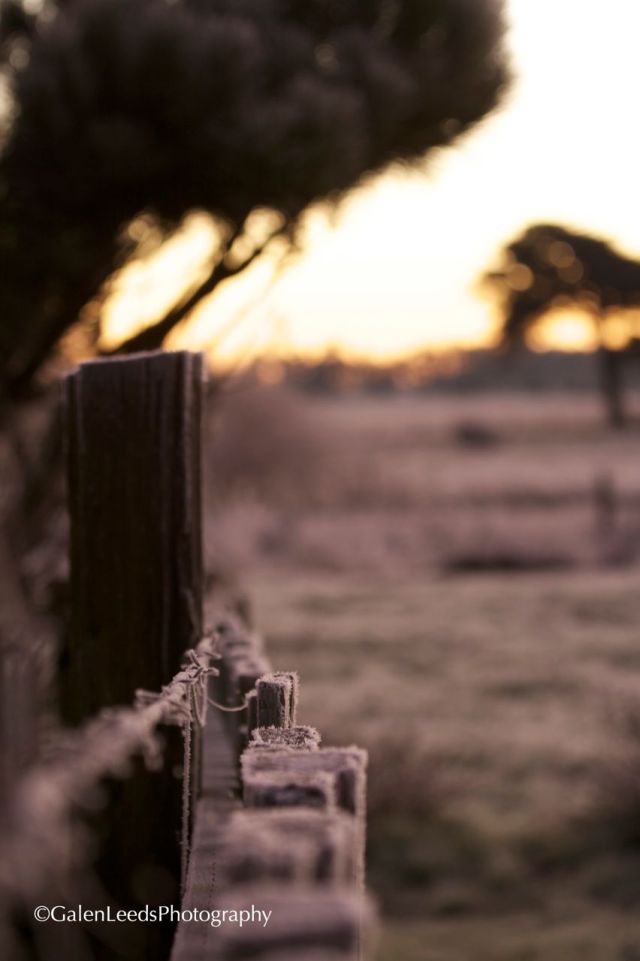
Notice the very shallow depth of field

This early morning picture of a frosted fence illustrates the affect that aperture can have on a photograph. The closer you focus to where you are standing, the shallower your depth of field will be. For this photo I had my aperture as wide as it would go (f 4.0) with the lens I was using (70 mm). This medium long lens, mixed with the very wide aperture gives the image an especially shallow depth of field.

If I was farther from the point I was focusing on, more of the fence would be in focus. Likewise, if I stopped down the aperture somewhat- even to f 8.0 or 12, you would notice a fair difference in how much more would be in the focused range.

I placed the focal point off center. I also found a spot where the fence had a slight bend. Imperfections such as slight curves can be more interesting than straight lines. They can lead the eye around the picture instead of just along a single line.

For exposure, I am almost overexposed on the sunlit sky (it is only a hair from being burned out), but almost underexposed everywhere else. My camera’s exposure meter actually says I was overexposed by 2/3 of a stop, but that is because of the false reading from the brightness of the sky. The exposure meter doesn’t lie, but it can be misleading, as it isn’t always reading on what we want it to.

Enjoy.

Posted in How To, nature photography, photography, weather | Tagged , , , , , , , , | 4 Comments

Anatomy of a photo #9: Harbor Seal portrait


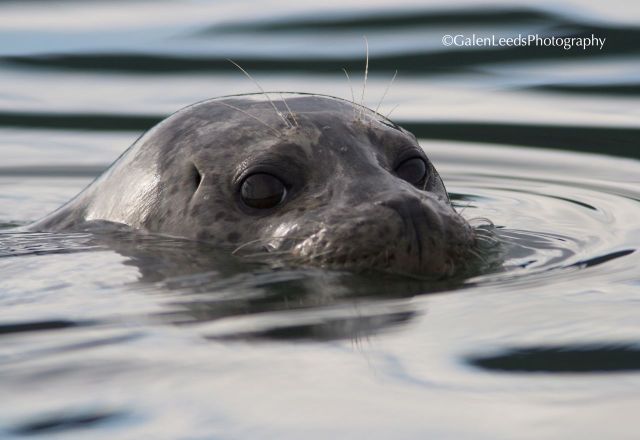
Harbor Seal portrait

I captured this image the first time I took my dad kayaking. It was early one afternoon in Tomales Bay, when the winds were calm. While I have seen many seals on the bay, we were lucky on this day with how many were surfacing around us, and how closely.

We didn’t try to approach any of them, but rather chose a course and paddled straight. I’ve found the best way to get close to seals is not to approach them, but to let them approach me. They are curious but shy. They love surfacing behind kayaks for example, so they can watch without being seen.

I had already taken some test shots with my camera to make sure that my exposures were close to what I wanted. With kayak photography this can be especially important, since there is so much extra light being reflected by the water that things don’t always expose quite how you expect. Often times it will become necessary to compensate your camera’s settings, although cameras are getting smarter and smarter.

I used a longer lens for this photograph, 300mm with a 1.4x booster, to keep a respectful distance from the seals. There was a hood on the lens to keep sun and reflected light from the glass at the front of the lens. A hood is especially helpful when kayaking to keep stray water droplets from confusing the autofocus. (For more tips on wildlife photography while kayaking visit here.)

I made sure to focus on the eyes. I did this by having moved my autofocus point to the side of my camera, instead of just using the center default focus location.

The near lack of winds is why the water is so reflective. If you will be photographing water, wind can play a huge role in the appearance of that water, so pay attention to the weather.

For more tips on photographing seals while on the water read Seeing and photographing seals when kayaking

Posted in Anatomy of a photo, kayak photography, photography, seals, wildlife photography | Tagged , , , , , | 4 Comments

Anatomy of a photo #13: Sunlit waves


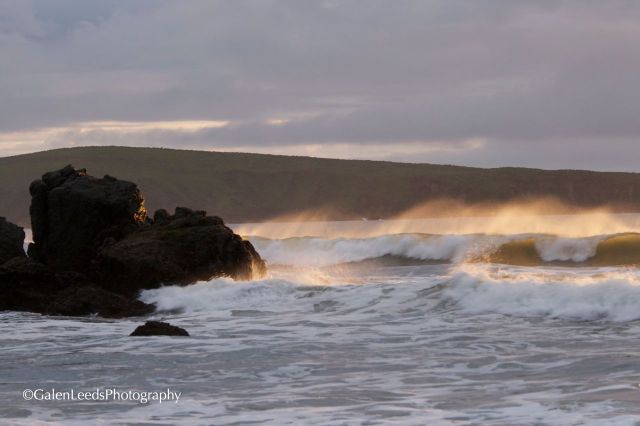
Sunlit waves at Dillon Beach

This image highlights the importance of being willing to head out for pictures, even when the weather is crappy… or even because of bad weather. I took this picture during a break in a storm at a nearby beach. The day was ugly, the light was blah, but often on these sorts of days you can get a break in the clouds that can add some interesting effects. This was one of those days. A shaft of sunlight came down from the sun as it was lowering in the sky, hitting the backs of these waves. Clouds and grey can also add a touch of the dramatic at times or a sense of mood that you can’t find on a sunny day.

I made sure my shutter speed was fast enough to mostly freeze the waves (there is a little blurring of some of the spray, which helps to add a little bit of movement to the image). The exposure was set to give the spray on the backs of the waves a nice golden glow, without overexposing them (something that would be easy to do with everything else in the picture being a little bit on the darker side). I had my camera on manual exposure settings to do this, but it also could have been done with a cameras exposure compensation values, putting them into the negative by about two-thirds of a stop.

For lenses I used a 70-200mm, zoomed out to 104mm. I wanted good detail on the waves, but to show enough background to give the waves a sense of place. I’ve taken many pictures zoomed in on waves and showing just the wave, but after a while these get a little boring without having a wider context or something else of interest in them. The medium focal length also increases the depth of field more than what the 200mm would have given, making the background more in focus. If I had been zoomed in closer, everything farther from the rock and waves would have been more blurred out, losing some of that sense of location.

I think that is most of the nitty gritty. Enjoy.

Posted in Anatomy of a photo, landscapes, nature photography, photography, weather | Tagged , , , , , , | 5 Comments

Anatomy of a photo #5: Bubble Jelly in Drake’s Estero


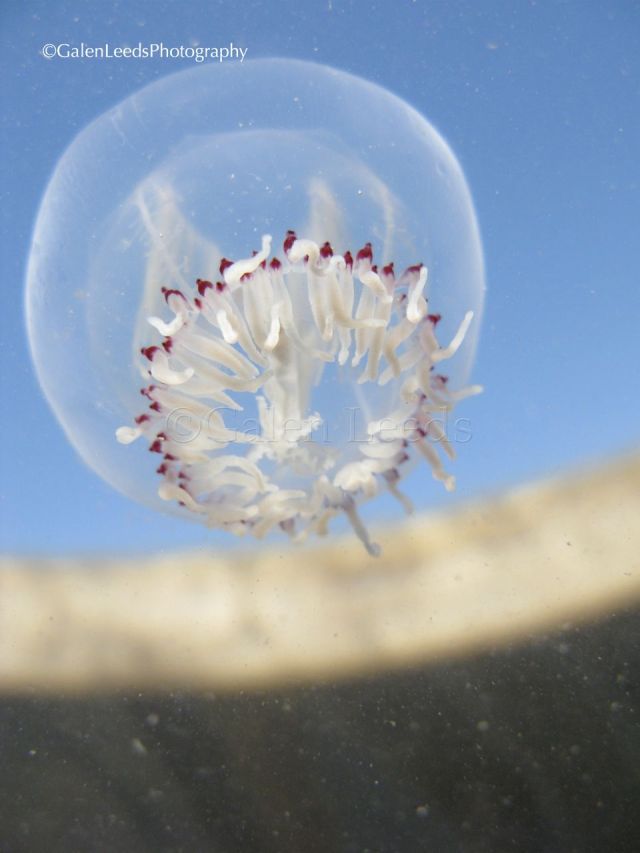
Underwater picture of a Bubble Jelly

This is a picture I took while kayaking in Drake’s Estero, a body of water lying within the Point Reyes National Seashore, one of my local parks.

This one was simple to take. I have a small, digital point and shoot camera with an underwater housing (these days I would just buy one of the many small digitals that can be used in and out of the water, instead of doubling my expenses by buying a camera and a housing).

I saw this really cool tiny jellyfish near the surface of the water. I have a macro setting on the camera, and I set it to that. I put my camera underwater (all settings automatic, but still in RAW shooting mode), put the camera right up to the jelly and took several images.

I had no way of seeing what I was doing (the screen was pointing towards the bottom of the estero, and the lens was pointing towards the surface) so I had to guess at composition. And got lucky. There were several that were fun, but this was my favorite.

The blurred light and dark lines in the background are the cliffs that line some of the shores of the estero.

Sometimes there can be a lot involved for successful kayak photography, but other times… The only thing special that I did in the first place was to be there, and then to put my camera in the water…

Happy shooting,

-Galen

Posted in Anatomy of a photo, kayak photography, marine life, nature photography, photography | Tagged , , , , , , | 9 Comments

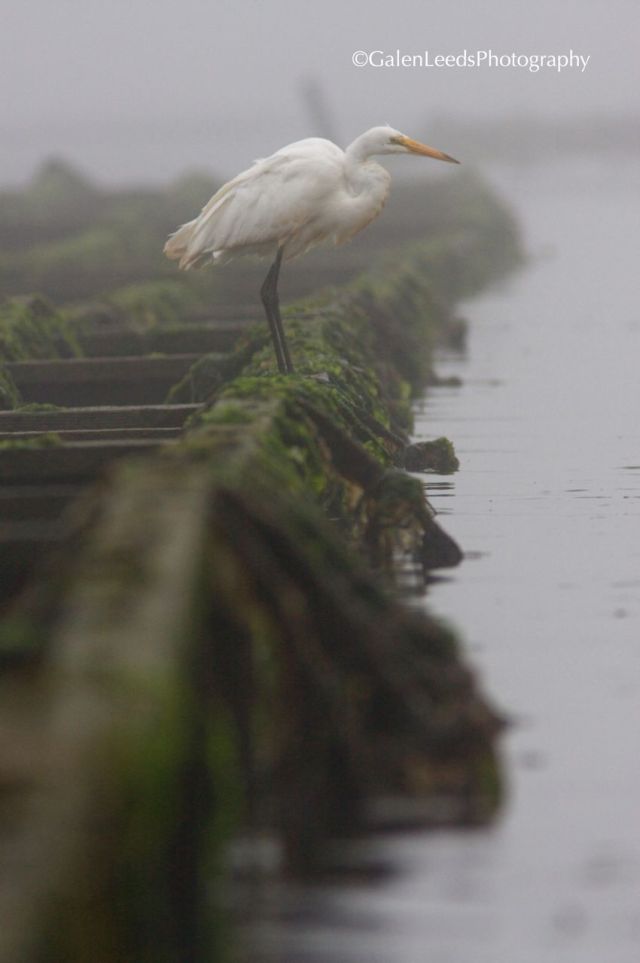
Anatomy of a photo #3: Great Egret hunting in the fog


Egret fishing from the oyster racks in Drake's Estero on a foggy day

This image was made while kayaking early one morning on Drake’s Estero.

When I saw this egret on the local oyster farm’s racks, I knew right away that I wanted a vertical orientation to the picture. The structure of the oyster racks are too visually interesting with their long patterned length to restrict to the small space they would have occupied in a horizontal or portrait orientation. The fog was thick though- you can see how the oyster rack is slowly fading away into the fog? This is one of the very few times I have adjusted the contrast of an image in post production on the computer. The egret itself was fading away into the fog, and I had to increase the contrast and darken the image a little to give the egret a little more solidity.

The egret was walking along the rack when I first saw it. The current wasn’t too strong, so I was able to almost stop my kayak so that I was viewing down the racks (which is the perspective I wanted). I took a picture or two in case the egret flew away, and then I waited for it to get to somewhere interesting- which is when I took this picture. I liked the way the egret was at the very edge of the rack. It gives the promise of a story.

For the more technical aspects… As I said, the image was made trickier a little trickier by how thick the fog was. It also cut down on the available light, so that when I used a long lens it had to be with a fairly open aperture (420mm at f6.4) for the image. Even though I usually like using open aperture for wildlife (I like the focus to be on the animal, which happens if everything else is a little blurred out), I didn’t have much of choice on this day. With little available light, I already had the ISO as high as my camera could manage without becoming too noisy (this was at ISO 800 and you can see there is already a little noise to the image). I couldn’t lower the shutter speed any farther without risking lots of camera shake. That meant the only thing that could adjust easily was my aperture.

The egret’s head is toward the top of the image. This is the main point of interest on the bird, so I avoided placing it in the very center of the picture. It’s not right at one of the 1/3 rd marks though either, but that’s just a guide, not a law (which I further break by more or less centering the egret from left to right).

Enjoy,

Galen

Posted in Anatomy of a photo, birds, kayak photography, nature photography, photography | Tagged , , , , , | 4 Comments

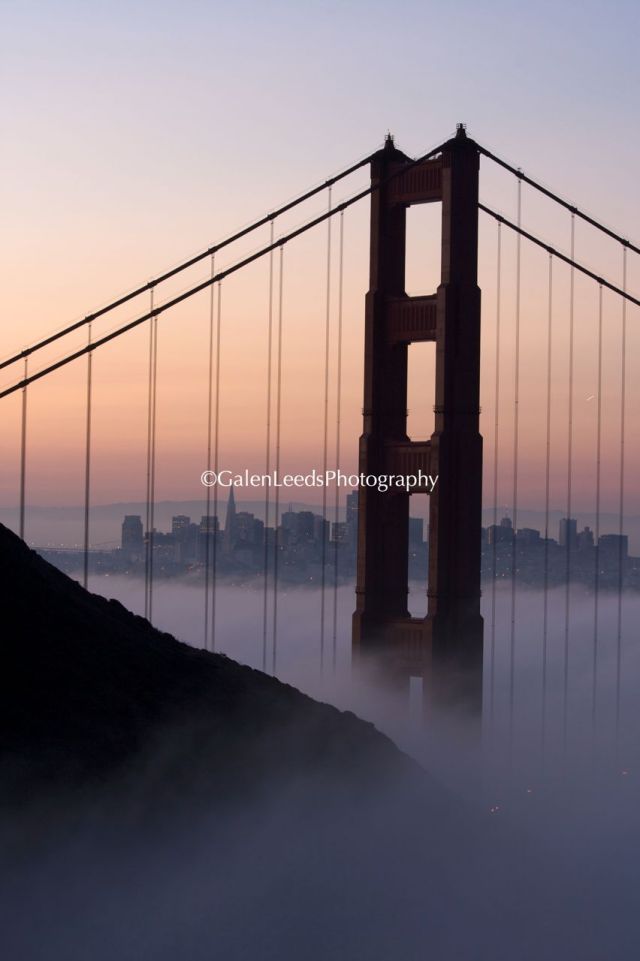
Anatomy of a photo #4: Golden Gate at Sunrise


I often feel silly taking pictures of the Golden Gate Bridge… It’s been photographed so many times, by so many people (likely it is one of the most photographed object in the bay area), at so many different times of the day in so many different conditions. I imagine that there are days when tens of thousands of pictures of it are taken, especially now that everyone has a camera in their phone or on their person. It’s hard to imagine taking a shot that hasn’t been taken before… Yet I too am caught up by it, and always seem to end up taking a picture or two of it whenever I am in the area and the light seems nice. I suppose that is what you would call photographic charisma, and would be the reason why it is a Bay Area icon known around the world.

In my mind, the key to capturing a memorable picture of something that is over photographed is to capture it in a way that others might not. How do you do this? Take the picture at times when others aren’t normally out, use an unexpected angle, focus on some part that others wouldn’t, use a wide angle when others would use a telephoto (or the opposite), get closer (or farther) than everyone else. These are just a few ideas. Photoshop is not one of those ideas for me. There was no processing of this image, other than adding the watermark to it. I did not add saturation or extra colors to the picture. There was no need.

One of the reasons I love getting up early to take pictures, is that no one else is up and about. There aren’t crowds. You can go where you want, take the pictures you want. It feels more private, the whole world feels closer. This picture of San Francisco’s most famous landmark was taken early one morning, when I was the only one around to witness a beautiful sunrise. I also wanted a sunrise picture, because I wanted pictures of the sun coming up over the bridge with San Francisco in the background. That can only happen in the morning.

I did not however know the exact picture I wanted to take. I had to see how the fog and the light were playing out together. I drove up and down the road a little, glancing constantly to the side. I when I saw something close to what I wanted, I stopped the car and parked (safely). I then hiked a ways from the road to get the perspective that I really wanted. (I didn’t want to be too high up, looking down on everything. Rarely can you get the exact shot you want from right on the road, and it can often pay off to move around just a little to find your angle.)

I set up my tripod- it would have been impossible to take a picture at this time of day without one- and set my cameras ISO to its lowest setting of 100. I wanted this to be a portrait with very little noise. I put my aperture at f10-so I would have a decent depth of field, but not have to shoot with too long of a shutter speed. There was a slight breeze, and the longer the image capture took, the more the tripod was prone to vibrate. I did some test shots and arrived at a shutter speed of 1 second. This kept some color in the sky, while not making the bridge and the city too dark.

I knew the sun would be coming up in the east, on the other side of San Francisco and a little to its left. Once the sun rose, I also knew that the bridge would become just a silhouette, that no color and little detail would be possible, because all of the light would be coming from the other side. (I did also take several pictures with the bridge silhouetted.) I played around with the composition a little more, switching from a wide angle to my 70-200 zoom. I wanted a tighter image than my wider lenses could give me. I wanted to be focused in on just the north tower, without the rest of the bridge. (I find that my 70-200 is actually one of my favorite landscape lenses… perhaps because not everyone uses it for that.) Vertical orientation helped to complement the shape of the tower, and it included many of the elements I was looking for.

And I took the picture.

All the set up, and then it is as simple as that- “I took the picture.”

Anyways, happy shooting,

-Galen

Posted in Anatomy of a photo, landscapes, Location, nature photography, photography | Tagged , , , , , | 20 Comments

Anatomy of a photo #38: Hawktopus


This is when I first saw that which I never imagined was possible

It was the middle of winter, less than two weeks past solstice, and there were rumors of whales in Tomales Bay. It was hard for me to put my kayak in the water before 4:30pm that week, but one day I decided to see how far I could make it before I lost all light- Could I paddle fast enough and far enough to make it where the whale had been seen while it was still bright enough to photograph from my kayak? Likely not, but it was worth a try.

I set out paddling hard. I knew it was a pace that would be difficult to maintain for long, but I was feeling driven. I cut across the bay on a different line than I normally would have, driving farther to the north, where I had come across whales before, and where I knew the water was deeper. I kept up the high speed rhythm I had settled into, instead of easing up as my muscles began to burn. The sun was already behind the hills, and the light was fading quickly. I didn’t know why I was carrying on, as my light was essentially gone already.

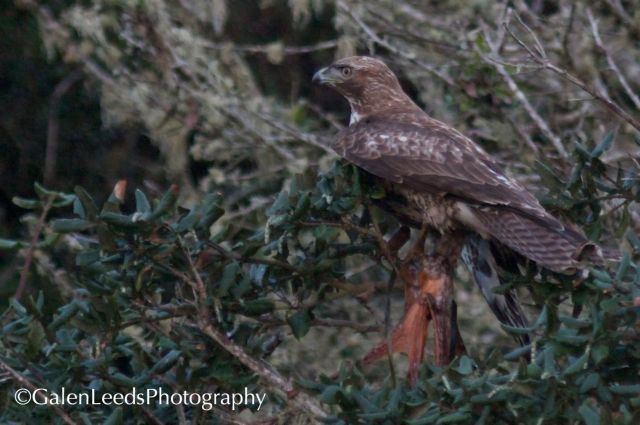
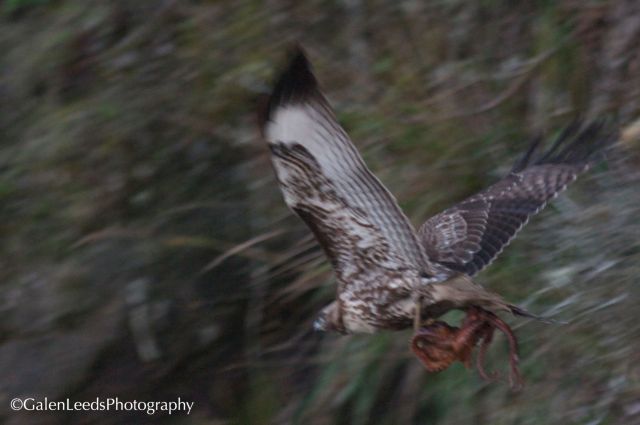
I had just reached the far shore and was adjusting my course more to the north when a juvenile Red-tailed Hawk flew into view, trailing something in its talons. I trained my ever present binoculars on it and felt my jaw drop (well, almost felt it drop). The hawk was carrying an octopus, something I could have imagined from an Osprey, but never a Red-tail.
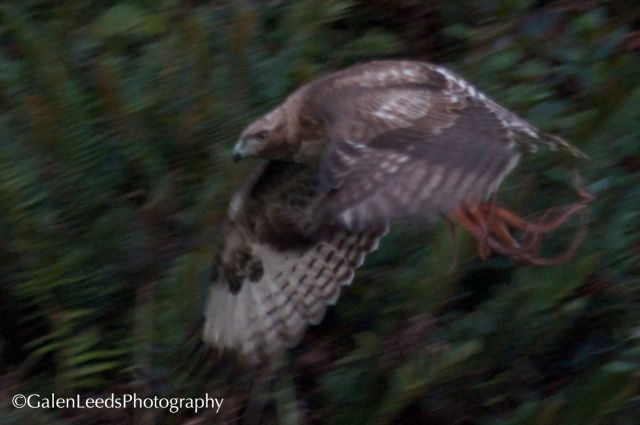
Red-Tail taking wing with its octopus prize

It landed near me in a low tree near the shore. I immediately began retrieving my camera from my dry bag (it was fairly well stowed away, as I thought it was so dark I wouldn’t be using it). I cranked the ISO up higher than I ever would have in normal circumstances- 1600. I didn’t care about noise now, I just new I needed to capture some images of this phenomenon. I opened up the aperture as wide as it would go, saying to heck with depth of field, and then set my shutter speed- 1/200th of a second.

The image was still a little dark, but I didn’t trust myself to be able to hand hold the camera steady enough to capture a crisp shot at a lower shutter speed, especially as I was shooting from my kayak, and a crisp image was imperative. I needed these photographs, I had to capture such an amazing prey in a Red-tails talons.

I discretely paddled a little closer, only a few hidden strokes, and then left my kayak to drift with its momentum very slowly toward the bird in the bush. Click. Click. It took wing. I’m not sure if it is because the Tail realized my proximity, or if it was because of the movement of the octopus (which was very definitely still alive), and it wanted a better perch for eating and killing. I captured several images as it flew off. These are blurred from the slow shutter speed that the low light necessitated, but much better these blurred images than none at all… the blurring even adds a sense of movement to some of the pictures.
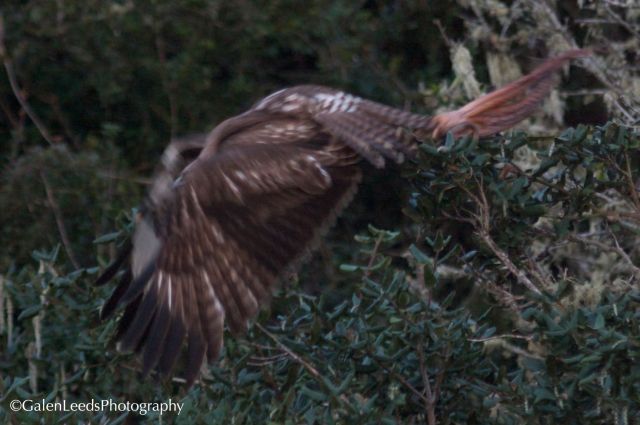
One of the first down strokes of the wings as it took flight with the octopus trailing from its talons

The bird flew around a small point with the octopus writhing in its talons. I followed, but it had disappeared.
I have since learned that it was an Octopus rubescens, or common coastal red octopus. They can shift their color depending upon their mood, and red is the color that shows they are angry. This one looks very angry with its deep red color.
It is very rare to see octopus on this bay. I had only seen them for the first time a few days previously.
And away it goes
Posted in Anatomy of a photo, hawks, marine life, nature photography, photography, wildlife photography | Tagged , , , , , , | 11 Comments

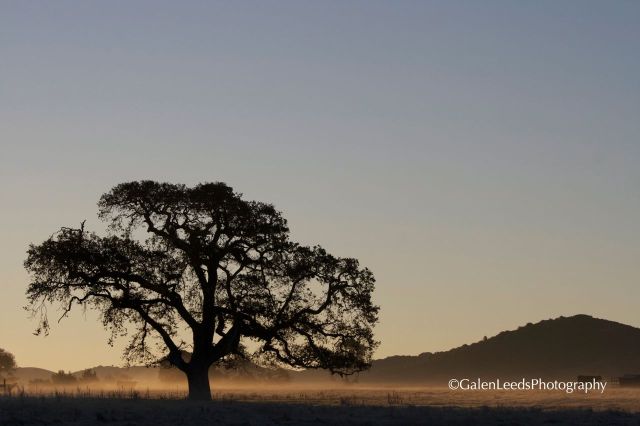
Anatomy of a photo #7: Oak Silhouette


I have different areas that I’ve scouted out over the years, that I know are interesting places for pictures. These are areas that I will visit early, early in the morning, when the light is going through its changes, when it is warm and magic. This silhouette of an oak tree is from one of those places. There is a series of old, twisted oaks in the middle of cow pasture. Each one is separated from the other trees by open spaces, so that it is possible to make portraits of individual, interesting trees. It’s good to have places in your head that you know you would like to shoot, rather than always hoping to chance upon an interesting scene while you are out and about.

For this image, I realized that I could nicely silhouette this oak, thanks to a low lying mist. If the mist hadn’t been there, the trunk of the tree would have been lost in the dark colors of the hills behind. The mist though, was lit up, giving something to contrast the tree against, and one thing that is important to silhouettes is that contrast.

To take this picture, I didn’t use the “classic” landscape lenses, which are generally fairly wide, taking in as much of the scene as possible. The lens used for this picture would be about a 125mm (in terms of the old 35mm film cameras). This allowed a tighter composition, that didn’t try to include too much. It’s sort of zoomed in on the oak. The slightly longer lens also gives a somewhat shallower depth of field, helping to keep the focus on the oak.

Next, I made sure to keep the oak out of the center of the picture. It is off to the side, and balanced in the image by the hill rising out of the mist on the right. The ground is down low, where ground should be, not splitting the center of the picture.

I manually set the aperture and time values, as I didn’t trust the camera to choose the exposure I wanted. If you don’t have this option on your camera, you should at least have a function for exposure compensation. The compensation would be towards the negative side, likely as far as your camera would allow you to adjust- usually  -2.0 is the maximum.

Posted in Anatomy of a photo, landscapes, nature photography, photography, road side | Tagged , , , , , , | 3 Comments

Anatomy of a photo #46: Young Raccoons on the rocks


Two young raccoons found on the rocky shores of Tomales Bay

Early morning, extra low tide, the long days of summer… Put them tgether, and it’s the perfect time to find and photograph raccoons as they search for crabs and tidbits by the first light of the day. The other time that seems to work well is toward the end of the day, as the world starts to get a little sleepy, and the nocturnals begin to awaken.

It was fairly late in the day when I found these two youngsters searching the shoreline for crabs, by feeling under the rocks, just as their mother had recently taught them. (I could tell these two were young from two different factors- short tails that weren’t as fluffy or darkly banded as an adults, and by their more diminutive size.)

I’d been paddling for a little while, and was hugging the shore as I headed north. This can be both good and bad for photographing wildlife from a kayak. It can be possible to get very close to wildlife, however you have no warning before you are upon them (which can make it tricky to get a picture before they scurry off and stress the animal). You can also miss seeing something much farther up the bay or lake, because your view can be cut off by the shore itself.

When you paddle from a little farther off shore, you can scan up and down the rocks and beaches so that you know what to expect and can plan for it. Many times wildlife on the shore doesn’t pay as much attention to things on the water, but you are very much in the open if you see an animal and try to approach more closely.

These two young raccoons I had no warning of. I rounded a corner, and suddenly there they were. And there I was, a little too close for their comfort. They quickly scurried into a hole in the rocks, but nearly as quickly their youthful curiosity and inexperience got the better of them and they had to pop back out to see what I was… So of course I took photographs.

I was using a telephoto lens 300mm plus a 1.4x converter, so that I had at least some distance from my subjects. My depth of field was set to the lower mid range- f8.0 so my depth of field was not too narrow, allowing both of the juvenile raccoons to be in focus. Shutter speed was fast, 1/800th of a second to make sure I captured all of the action.

The two youngsters emerged and resumed their hunting, finding a few tidbits to eat (here is a picture of one of them eating something here. I did not want to acclimate them too much however to the presence of people, so I did not stay long, and left them there foraging in the rocks.

Posted in Anatomy of a photo, nature photography, photography, Raccoons, wildlife photography | Tagged , , , , , | 5 Comments

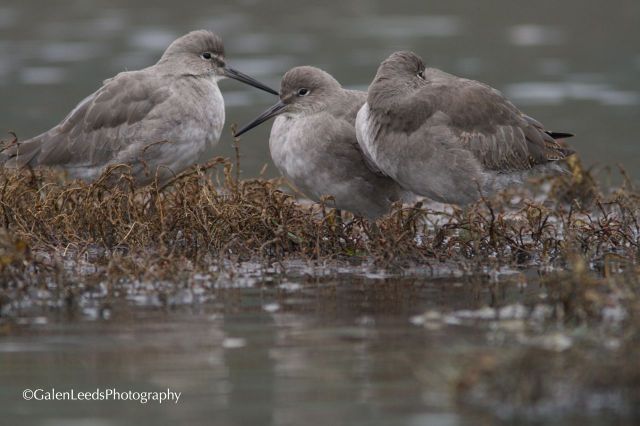
Anatomy of a photo # 14: Three Willets in pickleweed


Even though these are birds, it is still a portrait

As I look through my photographs of animal images, I notice more and more that there are two main lighting conditions that most of my favorite portraits were taken in- early/late low angle sun, or else while the subject was in a large shadow. The low angle sun adds warmth and dramatic lighting, while shadow (often because of cloud or fog, but sometimes from time of day and location) adds a moody, even lighting and provides for great detail without losing much to the contrast between highlights and deep shadows.

I made this image while kayaking Drake’s Estero on a foggy day. The even lighting gives the birds great detail. I used a fairly long lens for this portrait- 300mm plus a 1.4x magnifier. Since I was on a kayak, I had to hand hold this shot, which means I was shooting at the highest shutter speed I could without losing image quality. My ISO was 400 (the highest the camera I was using could do without noticeable noise) and my aperture was wide open at f 5.6. This allowed me a shutter speed of 400. With the lenses I was using, (they were image stabilizing) I might have tried dropping down to 200, but I know I would have lost some of the images I took to camera shake.

The shallow depth of field I was using worked very well for isolating the focus to the birds and a little of the pickleweed plant they are standing in. This is something I often like to do with portraits regardless, because it draws the viewers focus very strongly to the subjects. I also placed the heads and eyes in the top section of the picture, rather than along a line cutting through the center of the image when I composed the image. It gives it a more comfortable feel, and helps to fill the entire frame of the picture.

The composition is helped additionally by the low angle I took the picture from. I hunched down extra low in the kayak to be a little closer to eye level with the birds. When ever possible I like to be at or near the eye level of my subjects, be they birds, wild animals, livestock, or even little kids. It is hard to make a portrait when you are looking down at the top of somethings head instead of engaging the eyes.

Enjoy.

Posted in Anatomy of a photo, birds, kayak photography, nature photography, photography, shorebirds | Tagged , , , , | 3 Comments

Anatomy of a photo #42: Fallen star


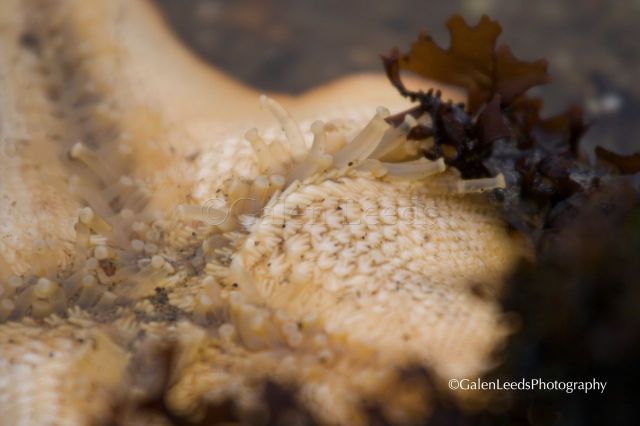
The underside of a star fish. It had peeled off of a rock at low tide and was out of the water

Paddling along Tomales Bay in my kayak one day, at a very low tide, I came across a star fish whose own weight had peeled it off of the rocks. I was enthralled by the various textures and shapes, the sucker-like tube feet reaching from the body, searching for a surface to grasp onto and right the fallen star.

I had a telephoto lens with me, with a “macro” function on the focus, and I began taking pictures at very close range. To do this, I switch the camera to manual focus, and set the focus as close to me as I can. I then move myself in and out from the subject until I believe that the parts I want in focus are so. I hold myself very still as I take several shots, since I know that this practice will often result in a few out of focus shots, no matter how still I try to hold myself, so I try to hedge my bets. If I am not trying to photograph something at the very edge of the focusing range, I will often leave the auto focus on and allow the camera to do its work.

The sun had already set behind the ridge I was kayaking under, so the lighting is very even- no deep shadows. Sometimes shade can be better for photographs than sun, because you won’t lose detail in the shadows. This did however mean that I was more limited in my shutter speed, ISO, and aperture in order to get the proper exposure. Using a 280mm I set the camera to ISO 100 for no noise and f/5.6 to have a shutter speed of 1/125th of a second. I wanted a very crisp image with the maximum detail, because I was so enraptured by the textures. It wasn’t until I was later, as I was reviewing the pictures on my computer, that I realized that many of the suction scales on the starfish’s underside reminded me of the hands of the characters of the animated series The Simpsons. Sometimes, you don’t realize what you have on your memory card, until later.

For photographs of starfish that have peeled off of rocks, only to be snatched up by hungry gulls, try reading Gulls and Starfish: An essay in photos

Posted in Anatomy of a photo, kayak photography, marine life, nature photography, photography | Tagged , , , , , , | 1 Comment