
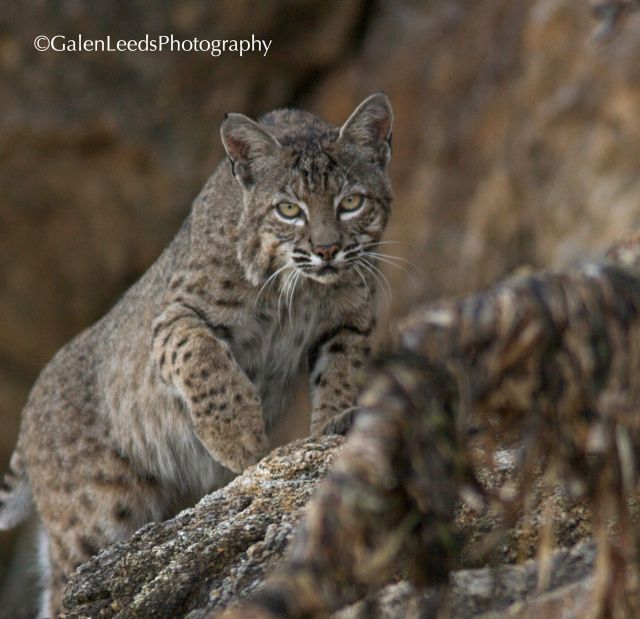
Bobcat stalking towards me along the shores of Tomales Bay. My kayak was beached at the time.
Over the years I have come across many bobcats. The most meanigful encounters I have had were while kayaking. Most of my photographs of bobcats were taken in the Point Reyes National Seashore. Here are some of those images-
And here is a little information about bobcats-
The bobcat, aka Lynx rufus, is one of the wildcats we have here in California, in fact among the twelve recognized subspecies, there is one native to the California area west of the Sierra Nevada- californicus. It may be the most common wildcat here in the U.S. of A., although it is largely nonexistent in the midwest. It prefers scrub, broken forest, and rocky and/or bushy grasslands, and will hang out a little in farmland type country. Which makes California, and especially the Bay Area, a pretty groovy zone for it.
It likely got its name from its “bobbed” tail, which is black at the tip, and white underneath. A lynx’s tail by comparison is black at the tip, and black underneath. There is often distinct banding or spotting on the upper legs, and a broken pattern of grays, blacks and whites on the face. They are shorter legged and shorter haired than the lynx (Lynx lynx.) The black tufting at the ears is usually less noticeable, all though still present than those found on the lynx. Males are larger than females. Average sizes are 28-49 inches, and 15-30 pounds.
Largely a solitary animal they mostly come together for the purposes of getting it on. The males can be sexually active year round, but the females generally only go into heat for the months of February or March. The cats mate through a series of fake hunting and chasing games.
Usually two to three (although up to seven,) cubs are born in late April to early May, covered in spotted fur. They are born in a special natal den (bobcats will often have a few different minor dens through out their territory.) They begin to move about and explore when they are about a month old, and are weaned by the time they reach their second month. They learn to hunt quite young, but usually stay with mom for the first year.
What don’t they eat. It seems like if its warm blooded and moving, they’ll eat it, although they will also eat carrion when food is scarce. Smaller animals such as rats, mice, and shrews, it will often sit very still for and pounce on them as they walk by. Larger animals such as rabbits, woodchucks, and squirrels, it will chase more actively. It will also eat opossum, raccoons, birds, cats, foxes, porcupines, and skunks. Rarely it will take down a deer, but it prefers to go after the young, or else adults when they are in snow and can’t move as freely, or else while they are bedded down to sleep. They will also go after livestock, especially poultry.
Most of this information was from the National Audobon Society Field Guide to North American Mammals, John O. Whitaker, Jr. It was however put into my own words and has my own spin on things.
Enjoy




 Galen Leeds Photography